浮 (uki) – “to float,” “ripen,” or “transient”
世 (yo) – “world,” “generation,” or “society”
絵 (e) – “picture,” “drawing,” or “painting”
You’ve probably seen this picture before:
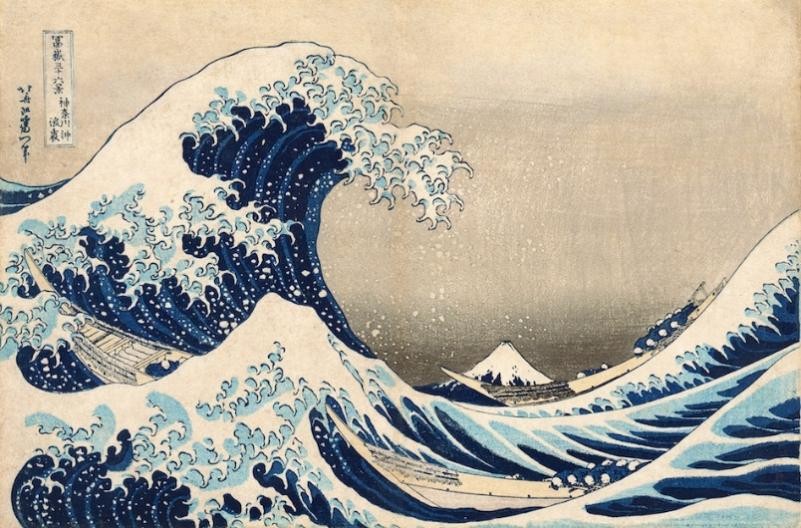
神奈川沖浪裏 (Kanagawa-oki Nami Ura, or The Great Wave off Kanagawa)
This is 神奈川沖浪裏 (Kanagawa-oki Nami Ura, or The Great Wave off Kanagawa) by Katsushika Hokusai.
You can find it on posters, notebooks, T-shirts, phone cases, and probably even a few things it has no business being on. But, here’s something you might not know: this incredibly famous image is a woodblock print, and it’s part of a Japanese art tradition called ukiyo-e (浮世絵).
While The Great Wave off Kanagawa might be one of the most recognizable examples, ukiyo-e was about much more than beautiful landscapes! We’re talking celebrities, fashion, theater, everyday life, and even the occasional ridiculous cat.
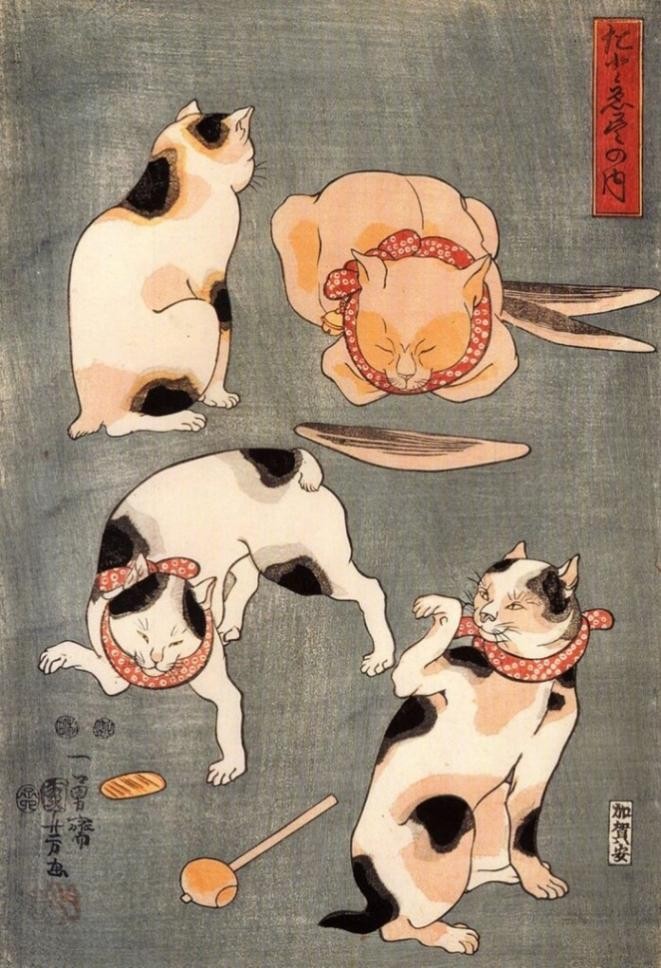
たとえ尽の内 (Tatoe-zukushi no uchi or Four Cats in Different Poses Illustrating Japanese Provers) by Utagawa Kuniyoshi
Of course, ukiyo-e didn’t just appear out of nowhere.
Japan already had a pretty impressive artistic history by the time these prints became popular, and Kyoto, the old imperial capital, played an important role in shaping it.
Long before ukiyo-e became popular, Kyoto was already an important center for Japanese art. Think beautiful ink paintings, elaborate folding screens, calligraphy, and illustrations of classical literature.
You can probably recognize some of these styles from historical shows or museums, particularly those dramatic landscapes with mountains disappearing into clouds.
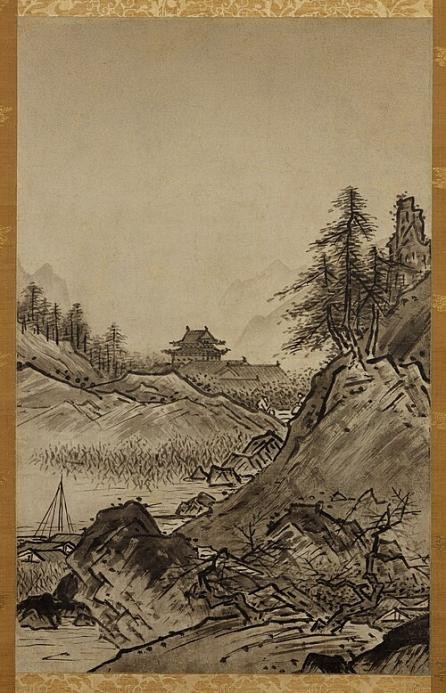
秋景山水図 (Shūkei Sansuizu or Autumn Landscape) – Sesshū Tōyō
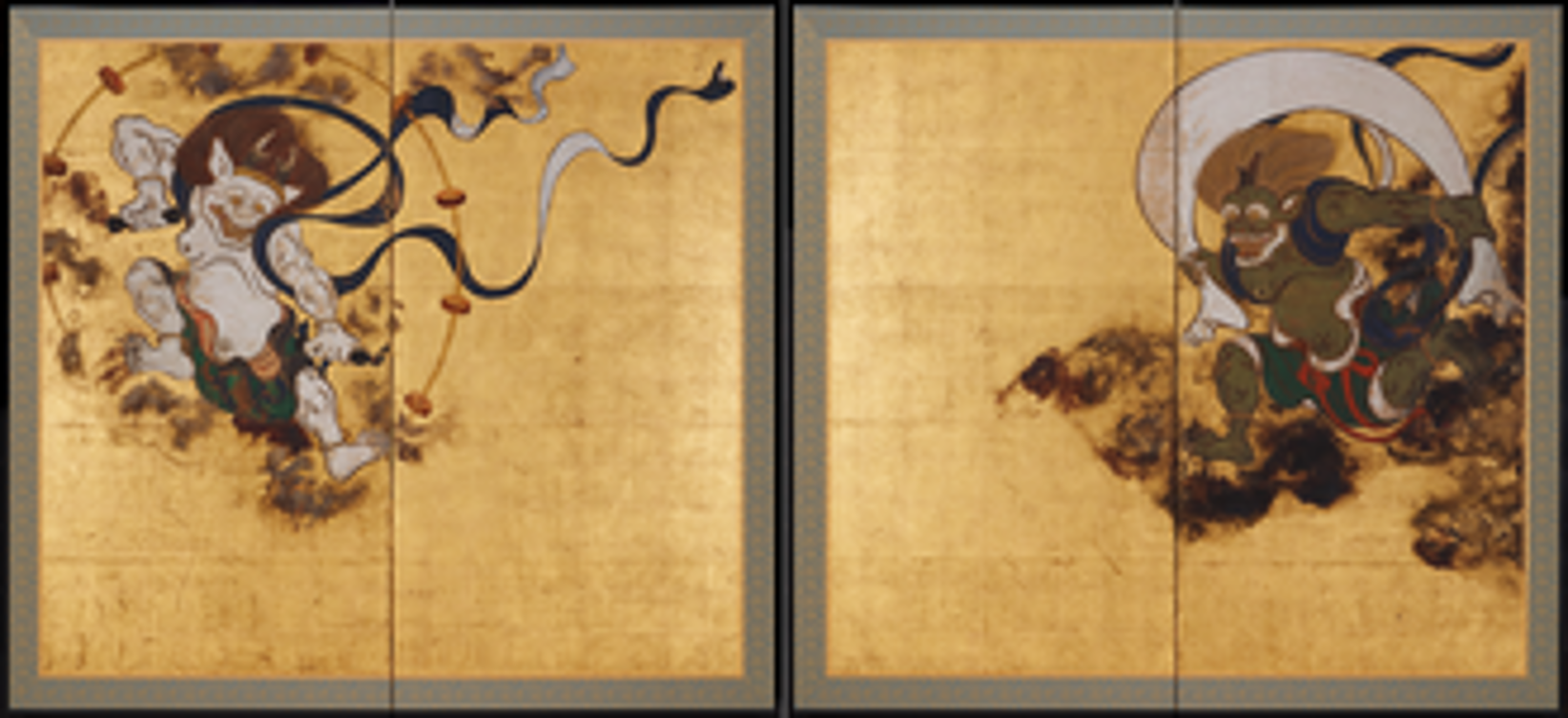
風神雷神図屏風 (Fūjin Raijin-zu Byōbu or Wind God and Thunder God Screens) – Tawaraya Sōtatsu
Much of this artistic culture was supported by wealthy patrons, religious institutions, and powerful families. Not exactly the sort of thing everyone could afford to hang in their living room…
But things changed, as they do!
In 1603, the Tokugawa Shogunate established its government in Edo, which is modern-day Tokyo. Kyoto remained the imperial capital, but Edo quickly grew into a major center of commerce and entertainment. With that growth came a new audience for art.
Merchants and townspeople were gaining economic influence, even if Japan’s rigid social hierarchy didn’t necessarily reflect it. They had money to spend, interests to explore, and apparently, a growing appetite for entertainment.
And some of that entertainment involved poetry parties. That’s right, poetry parties! People would gather to compose verses, exchange jokes, and show off their creativity. Some groups even commissioned beautifully illustrated woodblock prints featuring their poems, which they could then exchange as gifts. These special prints were called surimono (摺物), and they combined poetry with the artwork of ukiyo-e artists.
Imagine attending a gathering, writing a particularly clever poem, and then having it turned into an illustrated print by a team of artisans to share with your friends. Not a bad souvenir!
Of course, these gatherings weren’t open to absolutely everyone. Wealth and education still played a role, but they demonstrate how art and literature could bring together people from different social backgrounds through a shared interest.
And while some people were commissioning elaborate prints for their poetry clubs, publishers were discovering something else: there was money to be made selling pictures and stories to the public.
And one way publishers did this was through something we might recognize as a (very) early predecessor to Japanese manga.
Akahon (赤本) or “red books,” were small, inexpensive illustrated books that made stories and entertainment accessible to a wider audience. They featured everything from traditional folk legends to children’s stories and fairy tales, giving readers a way to enjoy illustrated stories without spending a fortune.
Over time, Japanese illustrated storytelling continued to evolve, eventually contributing to the rich visual culture that gave us modern day manga and anime.
But what happened to ukiyo-e itself?
Well, it hasn’t disappeared completely. In fact, it can still bring people together across generations and even help overcome language barriers.
Take me, for example.
Your humble writer is still learning Japanese, but when I first started, man, was it rough. The amount of vocabulary I needed just to participate in a conversation felt staggering.
Fortunately, art doesn’t require quite so much vocabulary.
One day, after finishing kendo practice, my teacher was checking in on me and asking about my studies and interests. When I mentioned my interest in the Edo period and ukiyo-e, he told me that his wife had a collection of prints and offered to introduce us.
Now, I clearly didn’t understand everything he was telling me, because I thought this would be a simple introduction.
It was not.
Instead, I found myself standing in a dojo with practically the entire floor covered in prints belonging to my teacher’s wife (who, I should mention, is an excellent kendo practitioner in her own right!).
While I couldn’t fully express how grateful I was to see her collection, we were able to walk together through the rows of prints, pointing out interesting details and sharing our appreciation for the artwork.
That experience has become a core memory from my early days of studying Japanese.
I even shared the story with my parents, who became interested in seeing ukiyo-e for themselves! That eventually led us to a shop in Tokyo called Mokuhankan, where traditional Japanese woodblock printing is still very much alive. But these aren’t necessarily the kinds of prints you’d expect to find in a history museum; alongside traditional designs, Mokuhankan produces prints inspired by modern pop culture, including some rather familiar video game characters.
Have a look for yourself, and see if you recognize any!: https://mokuhankan.com/subscriptions/portraits.html
So, while ukiyo-e might have started centuries ago, it’s certainly not going anywhere just yet. From Edo-period poetry gatherings to modern prints featuring familiar characters, the art has continued to find new ways to bring people together. And who knows? Maybe the next time you come across a woodblock print, you’ll find yourself looking a little closer. You might discover a piece of history, a new favorite artist, or even have a conversation you wouldn’t have had otherwise.